Why these rules matter now
Most of the lawyers I work with picked up ChatGPT or Claude in 2023, used it on a few low-stakes drafts, and never went back to read the ethics rules. That worked when AI use was a side experiment. It does not work in 2026, when the typical small firm has staff using a generative tool every day and several state bars have moved past the “general guidance” stage into specific rule changes.
This article walks through the rules a working lawyer should know: the American Bar Association’s Formal Opinion 512 from July 2024, the underlying ABA Model Rules of Professional Conduct, and the state bar opinions that have layered on top. The goal is not to replace your bar’s guidance. It is to give you a working summary so you can read your own bar’s opinion with context, build a firm AI policy that holds up, and stop relying on whatever your IT vendor wrote into a sales deck. For the broader picture of where AI fits across firm operations, see the pillar on AI for law firms. For the policy itself, see AI policy for law firms.
One disclaimer up front: this is education, not legal advice. We are not lawyers. Confirm anything that drives a compliance decision with your own bar’s opinion, your malpractice carrier, and a colleague who handles ethics work in your jurisdiction.
What ABA Formal Opinion 512 actually says
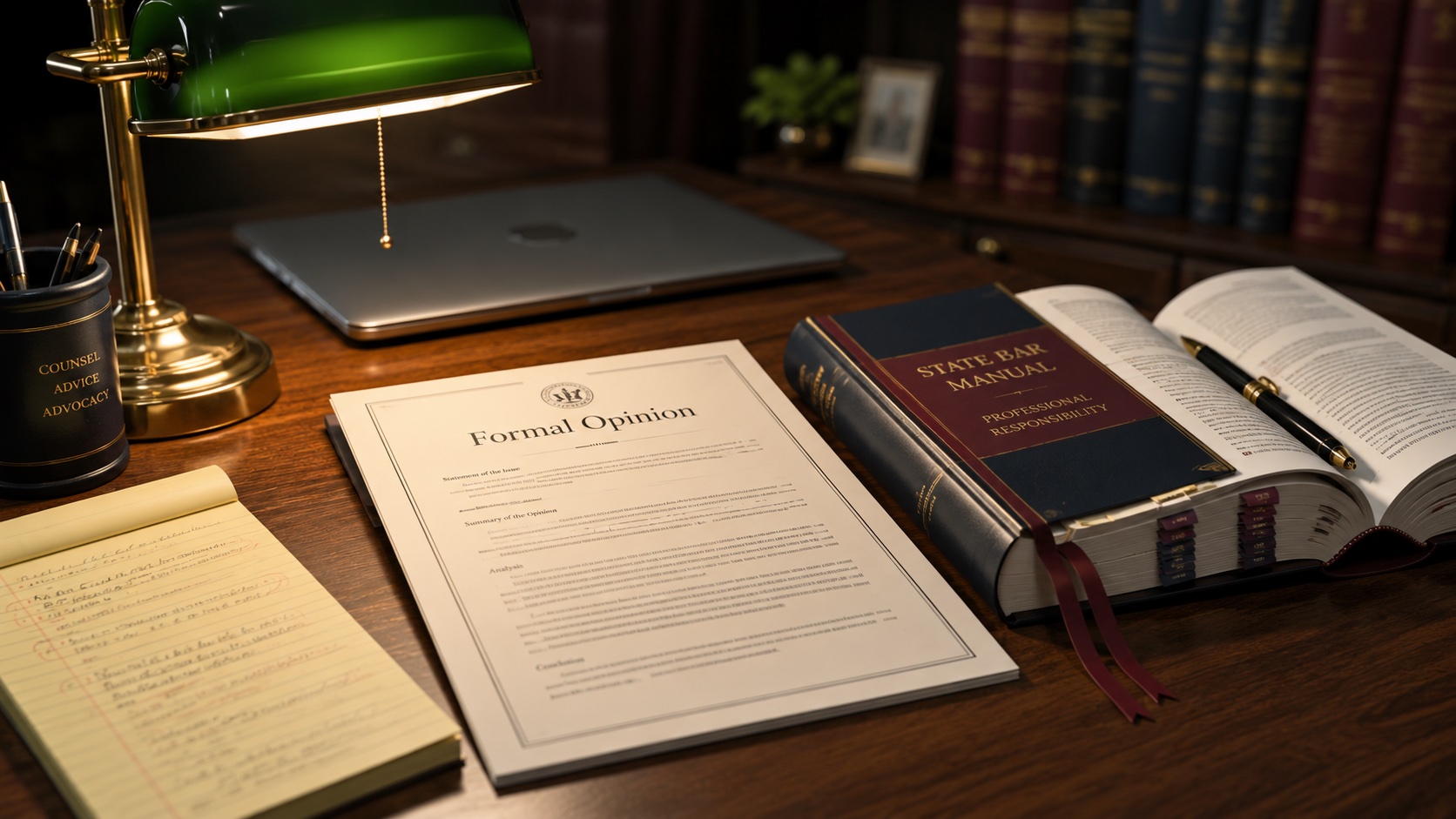
Op. 512 is the first comprehensive ethics guidance the ABA issued on generative AI use by lawyers. It runs about 15 pages, references several Model Rules, and answers the question lawyers were asking in 2023 and 2024: do the existing rules cover AI, or do we need new ones? The answer the committee gave was that the existing rules cover AI. They just need to be applied with the technology in mind.
The opinion organizes itself around a small set of duties. Each one maps to an existing Model Rule and gets a paragraph or two on what the rule means when a generative tool is in the loop.
Competence (Model Rule 1.1)
Lawyers are required to provide competent representation, which the opinion says includes a working understanding of the benefits and risks of any technology used to deliver legal services. You do not need to read the model card or the system prompt of every tool you use, but you do need to know what kind of tool it is, what data it sees, what it is trained to do well, and where it tends to fail. The Mata v. Avianca sanctions in 2023 happened because the lawyers in that case treated ChatGPT like Westlaw. Op. 512 does not let that excuse stand.
Confidentiality (Model Rule 1.6)
This is the section the opinion spends the most time on. Lawyers stay responsible for client information no matter what tool processes it. The opinion specifically calls out that you have to know how a generative tool stores and uses your inputs, whether the vendor trains its models on your data, and whether the tool’s terms protect privileged communications. Boilerplate consent buried in an engagement letter is not enough; the committee says lawyers should obtain informed client consent before using client confidences in a generative tool, and that consent should be specific enough that the client understands what is happening.
Communication (Model Rule 1.4)
Most clients do not need a play-by-play of which tools you used on their matter. The opinion does say you may need to disclose AI use when it would be material to the representation, when the client asks, or when the use is significant enough to affect the client’s decisions about the representation. Disclosure becomes more important when the tool is touching the substance of legal work, not when it is checking spelling.
Candor toward the tribunal (Model Rule 3.3)
This is the post-Mata v. Avianca obligation. Lawyers are responsible for every citation, every quotation, and every factual claim in anything they file, regardless of which tool helped draft it. The opinion treats AI hallucinations the same way the rules treat any other source of factual error: the lawyer who signs the filing carries the duty to verify.
Reasonable fees (Model Rule 1.5)
Op. 512 takes a clear position on billing. A lawyer can bill for the time spent prompting the tool and reviewing its output. A lawyer cannot bill the client for the model’s processing time, and in most cases cannot bill for the time it took to learn how to use the tool in the first place. The fee section also raises a double-billing issue: if AI lets you do in 20 minutes what used to take 2 hours, billing for 2 hours is no longer defensible under Rule 1.5’s reasonableness standard.
Supervision (Model Rules 5.1 and 5.3)
Partners and supervising lawyers stay responsible for their staff’s use of AI tools, the same way they stay responsible for any other delegated work. The opinion specifically extends Rule 5.3 (which covers nonlawyer assistance) to cover the AI tool itself. Practically, that means firm policy, training, and oversight have to address generative AI directly. Treating it as “the associates’ problem” does not satisfy the rule.
Charging for the cost of AI tools (Model Rule 1.5)
If the firm absorbs the cost of an AI tool as overhead, no client charge applies. If a particular matter triggers a measurable AI cost (a paid query through a vendor API, a per-document run on a contract platform), the opinion treats it the same as any other matter expense: charge it through to the client only if the engagement letter and Rule 1.5(b) requirements support it.
State bar guidance worth reading
Op. 512 is the floor. Several state bars have published their own opinions, and some go further than the ABA on specific points. Here are the four worth pulling up before you finalize a firm policy. The Justia 50-state survey tracks the rest.
California
The State Bar of California’s Practical Guidance for the Use of Generative Artificial Intelligence in the Practice of Law, approved by the Board of Trustees in November 2023, was one of the first comprehensive state-level documents. In May 2026 the State Bar’s Standing Committee on Professional Responsibility and Conduct (COPRAC) proposed amendments that would write specific AI obligations directly into the rules: a lawyer using AI must independently review, verify, and exercise professional judgment over every output, with no carve-out for routine tasks or low-stakes matters. If you practice in California, the COPRAC proposals are worth tracking through the comment period.
Florida
Florida Bar Ethics Opinion 24-1 is the most concrete state-level opinion on billing and disclosure. It requires Florida attorneys to disclose AI use to clients when that use affects fees or costs, and it addresses the confidentiality questions at the same level of detail as Op. 512. For a Florida firm, the engagement-letter language has to reflect that disclosure rule directly.
Texas
Texas Professional Ethics Committee Opinion No. 705, issued in February 2025, focuses on human oversight of AI work product. The opinion is direct about the post-Mata v. Avianca lesson: every AI-generated output that touches a filing has to be reviewed by a competent lawyer, and that review has to include verifying any citation the tool produced.
New York
The New York State Bar’s Formal Opinion 2025-6 is narrower in topic but useful in scope. It addresses AI tools that record and transcribe client meetings, and it requires informed consent before recording, plus specific confidentiality safeguards on the transcript. If your firm uses Otter, Fireflies, or a similar tool for client calls, this opinion is the controlling guidance for New York-based practice.
Oregon and the rest
Oregon’s Formal Opinion No. 2025-205 and a growing list from Illinois, Pennsylvania, North Carolina, Washington, and Virginia track the same themes: competence, confidentiality, supervision, and verification. The pattern across opinions is consistent enough that a firm with a working AI policy aligned to Op. 512 will satisfy most state bars by default. The exceptions are the disclosure and verification rules where a state has gone further than the ABA, like Florida and (pending) California.
What this looks like in daily practice
A working policy that follows Op. 512 and the state-level overlays comes down to five habits. None of them require new software. They do require deciding the rules in advance and writing them down.
First, a tool inventory. Know which tools your firm has approved, which are prohibited, and which tier of each tool is in use. A free-tier ChatGPT account that may train on inputs is a different product from a ChatGPT Enterprise seat with a no-training data agreement. The policy should list both the approved tools and the approved tiers.
Second, a redact-first rule for any matter that has not been cleared for a specific tool. If a staff member needs help drafting a motion and the only AI tool available is a free-tier consumer chatbot, the client identifiers come out first. Redact-first is the simplest way to cover Rule 1.6 confidentiality without slowing the work down.
Third, mandatory verification for any AI-generated work product that goes to a client, a court, or opposing counsel. This is the Mata rule. Every citation gets checked against the actual case. Every numerical figure gets reconciled with the underlying record. The lawyer signing the filing carries the duty.
Fourth, written informed consent for any matter where the firm will use an AI tool on materially substantive work. Op. 512 is clear that boilerplate engagement-letter language does not cover this. The simplest approach is a one-paragraph addendum or a separate consent form that names the tool, names the type of use, and notes the confidentiality protections in place.
Fifth, a billing rule that lines up with Rule 1.5. Bill for prompt-writing and review time. Do not bill for the model’s processing time. Do not bill the same number of hours for work the AI cut in half. If the firm uses a flat fee or a fixed fee, the issue largely goes away. If the firm bills hourly, the timekeepers need to know the rule.
None of this is exotic. A firm that already has a written confidentiality policy and a written engagement-letter template can fold the AI rules in over a quarter. The firms that get into trouble are the ones operating without a written policy at all. Those are the firms most exposed if a court inquiry or a bar complaint surfaces six months from now.
Verify with your own bar before you rely on any of this
Two reminders before this article ends.
One: the rules are moving. ABA Op. 512 came out in July 2024, and the state opinions have been published at a steady pace since. By the time you read this, your bar may have published a new opinion, amended an existing one, or proposed a rule change like California’s COPRAC package. Always check your bar’s current ethics page before basing a firm decision on a summary like this one.
Two: this is not legal advice. Business AI Workflows is an SEO and content site for small businesses, written by a consultant who works with law firms. We are not lawyers and we do not represent law firms in their bar matters. If you need to make a compliance call that has malpractice exposure, run it past your bar’s ethics hotline, your malpractice carrier, and a colleague who handles ethics work in your jurisdiction. The cost of a 30-minute consult is rounding error against the cost of a sanction.
Related on Business AI Workflows
- AI for law firms: the pillar overview of where AI fits across firm operations.
- AI policy for law firms: the copy-pasteable policy template these rules map to.
- Best AI tools for law firms: the vendor-neutral tool roundup.
- AI for personal injury lawyers: practice-area implications for PI firms.